
0

theme /
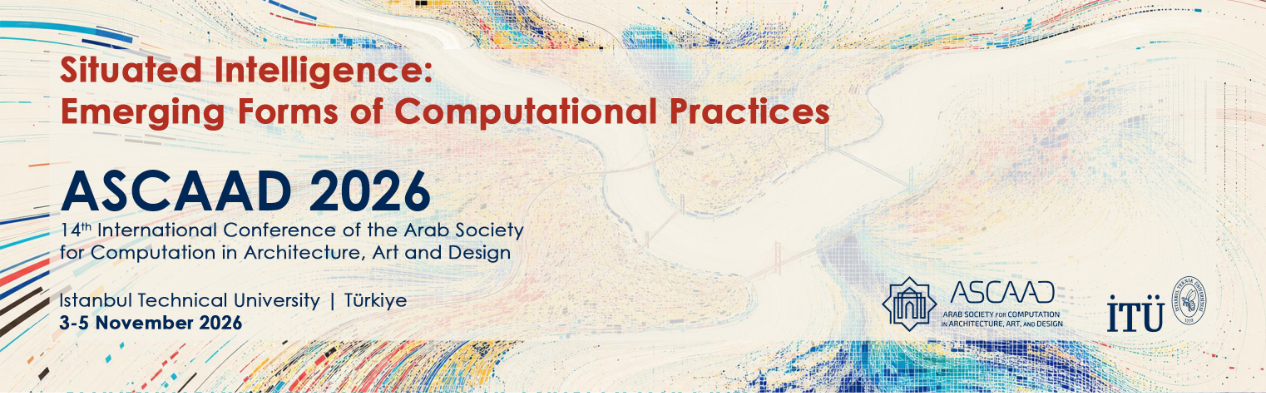
Situated Intelligence - Emerging Forms of Computational Practices
Computation no longer operates as a detached digital process or purely technical domain. Across contemporary spatial practices, intelligence increasingly emerges through intertwined relationships between data, materials, infrastructures, environments, bodies, machines, networks, and collective agency. Artificial intelligence, responsive systems, digital fabrication, sensing technologies, robotic environments, and hybrid realities continuously reshape how architecture and urban space are imagined, produced, experienced, and governed. In this evolving landscape, data itself becomes dynamic spatial fields and relational “data landscapes” actively participating in the construction of environments, decisions, and cultural narratives.
ASCAAD 2026 approaches situated intelligence as an emerging condition in which computational practices become inseparable from context. Emerging computational paradigms are increasingly shaped by geography, ecology, material practices, memory, politics, climate, language, and local forms of knowledge. Emerging forms of computational practice increasingly operate through adaptive interactions between physical and digital realities, biological and synthetic systems, local traditions and global infrastructures, human intuition and machine learning. From computational heritage to AI-assisted design, from responsive urban systems to immersive environments and robotic fabrication, computation unfolds through negotiated relationships between space, culture, environment, technology, and collective experience.
These transformations increasingly destabilize inherited distinctions between natural and artificial systems, physical and virtual environments, representation and simulation, and authorship and automation. Computation no longer functions solely as a tool for modelling or optimization, but as an active participant in the production of spatial knowledge, material organization, environmental interaction, and cultural meaning Architecture and design are therefore confronted with new forms of agency shaped through feedback, sensing, adaptation, and exchanges between humans, machines, materials, and environments. Such transformations call for new conceptual and methodological frameworks capable of addressing evolving relationships between computation, culture, ecology, and spatial practice.
ASCAAD 2026 seeks to foster critical discussions on the cultural, spatial, ecological, and epistemological implications of computation. The conference invites researchers, designers, artists, technologists, and educators to explore situated and context-aware approaches capable of engaging with the complexities of contemporary spatial practice. By bringing together perspectives across architecture, urbanism, media, fabrication, computation, and environmental systems, the conference aims to investigate how emerging ecologies of intelligence reshape relationships between information, matter, agency, culture, and the built environment.
Conference Host /
The conference is hosted by the Faculty of Architecture at Istanbul Technical University (ITU), one of the oldest technical universities in the region, with a 253-year academic legacy, located within the historic Taşkışla Building in the heart of Taksim, Istanbul. As a city that has served as the capital of multiple civilizations across centuries, Istanbul embodies a uniquely layered condition shaped by continuous cultural exchange, migration, infrastructural transformation, and evolving relationships between East and West, North and South, tradition and technological modernization. Positioned at the intersection of Europe, the Middle East, the Mediterranean, and wider Afro-Eurasian geographies, Türkiye occupies a critical spatial and cultural threshold within the broader contexts of the MENA region and the Global South. Through its longstanding engagement with computational design, digital fabrication, robotics, immersive environments, AI-driven design research, and interdisciplinary experimentation, ITU provides a fertile platform for ASCAAD 2026 to critically explore situated forms of computation emerging across diverse cultural, ecological, and technological contexts.
topics of interest /
The ASCAAD 2026 conference invites submissions of original research papers to address the following topics including but not limited to:
1) Smart and Adaptive Systems
• Artificial Intelligence & Algorithmic Design
• Data, Simulation & Predictive Environments
• Human–Machine Collaboration & Creative Agency
• Digital Twins & Building Information Modelling (BIM)
2) Materiality and Making
• Digital Fabrication, Robotics & Material Systems
• Situated, Adaptive & Responsive Systems
• Design Tools, Creative Coding & Hybrid Workflows
• Computational Pedagogies & Design Education
3) Ecology and Urbanism
• Climate-Responsive & Ecological Design
• Computational Urbanism & Smart Environments
• Collective Intelligence & Participatory Design
4) Culture, Heritage, and Theory
• Computational Cultures, Heritage & Digital Humanities
• Vernacular Knowledge & Local Design Systems
• Computational Theory, Ethics & Critical Approaches
5) Immersion, Digital Media and Experimental Practices
• XR, Spatial Computing & Immersive Environments
• Interactive Media, Games & Spatial Narratives
• Experimental Design Research & Hybrid Methodologies
important dates /
| Call for papers | 27 | May | 2026 | |
| Deadline of abstract submission | June | 2026 | ||
| Notification of abstract acceptance | July | 2026 | ||
| Deadline for full paper submission | August | 2026 | ||
| Full paper acceptance notification | September | 2026 | ||
| Final conference papers submission | 11 | October | 2026 | |
| Conference Days | 3-5 November | 2026 | ||
Page last update: 16 August, 2026